
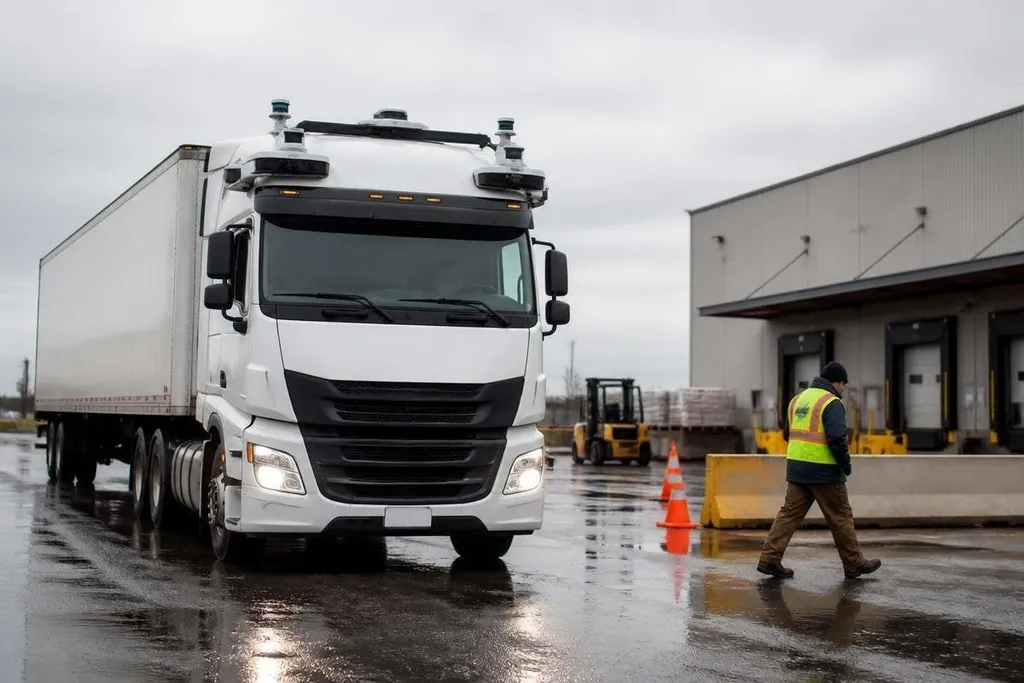
A self-driving truck may complete a long highway run with fewer steering inputs from a person. The harder work begins near warehouses, city streets, loading bays, road crews, bad weather, and people who do not behave like traffic models.
- Highway driving offers clearer lanes and fewer sudden obstacles.
- A remote operator may still need to help with unusual situations.
- Safety, jobs, insurance, and maintenance remain open concerns.
Where the benefits come from
Long highway routes have a fairly clear structure. Lanes are marked, traffic moves in the same direction, and the truck can use cameras, radar, LiDAR, and GPS to track its position and nearby vehicles.
That can cut routine steering and braking for a human driver. The vehicle could also keep moving for longer parts of a route because a person needs sleep. The gain depends on legal approval, the operating area, safety rules, and a plan for failures.
The savings may reach beyond the cab. A carrier could assign remote staff to watch several trucks, though each truck still needs a safe response when sensors lose sight of the road or software meets a situation it wasn't built to handle.
Fuel use may also change. A computer can hold a steady speed and leave measured gaps in traffic, but those gains depend on the truck's route, load, weather, road grade, and driving software. A claim about lower fuel use needs a test against ordinary trucks on the same route.
The hard part is the handoff
Highway travel often ends at an interchange or freight yard. That last stretch can include tight turns, parked trailers, faded markings, workers in reflective clothing, cyclists, and vehicles entering from odd angles.
The same vehicle may work well on a marked highway and still need a person in those areas. The handoff itself creates work: the system must tell an operator what it sees, the operator must understand the scene, and the truck must wait for a safe instruction.
Remote help also depends on a working communications link. A lost connection cannot leave the truck guessing, so the vehicle needs a safe response such as slowing down, stopping, or reaching a planned place away from traffic.
Road conditions add another limit. Rain can reduce camera visibility. Snow can cover lane marks. Construction can move traffic into lanes that did not exist when the map was made. The truck must detect the change and act safely without treating an old map as fact.
What can go wrong
A sensor can become dirty, blocked, or damaged. A camera may struggle with glare, while LiDAR can lose useful returns in heavy weather.
Software can also misread a temporary sign, a person directing traffic, or a vehicle stopped in a travel lane. A stopped truck can block traffic and put other drivers at risk, while a wrong turn can send a heavy vehicle into a street, bridge, or loading area that cannot handle it.
Cybersecurity adds another concern. A connected truck needs controls that stop an outsider from changing its route, braking behavior, or access to vehicle systems. Carriers also need logs that show what the truck sensed, what it decided, and who gave an instruction.
A route change made from outside the truck also raises a responsibility question: who answers when that change affects a worker, a carrier, or another person on the road? Robot24.com can help place that question beside the truck, control system, test date, and safety process before the discussion turns to jobs and rules.
Jobs, rules, and responsibility
Truck automation may change driving work before it removes it. A driver could spend more time on local roads, cargo checks, customer sites, and vehicles that need manual control. Remote staff, maintenance teams, mapping work, and safety review could also become part of the operation.
That change still affects pay, training, and job numbers. A carrier needs a clear plan for the people whose routes change, not only a purchase plan for trucks.
Responsibility must be clear after a failure. The carrier, truck maker, software supplier, remote operator, and maintenance team may each control a different part of the system. Insurance and local rules need to reflect that division.
I’d approve self-driving trucks on fixed, well-mapped routes only after the operator can show how the system handles failures, not only clean highway miles.
A practical buying check
Before a carrier signs a deal, check these points:
- Route limits: list the roads, weather conditions, terminals, and hours the system covers.
- Fallback action: record what the truck does after a sensor fault, map error, or lost connection.
- Human role: set the number of remote staff, their response time, and the cases that require a person on site.
- Safety records: ask for incident logs, disengagement records, and the method used to review each event.
- System access: separate driving controls from routine fleet software and test account removal.
- Cost model: include insurance, maintenance, mapping, remote help, training, and truck downtime.
The useful test is narrow: run the system on routes it can explain, then measure every stop, handoff, fault, and manual intervention. Until those records cover the warehouse entrance as well as the highway, self-driving trucks remain a route-specific tool rather than a general replacement for a driver.